MIA DAY
2025.9.29
Technology has never been neutral
Digital technology is not merely a convenient tool. Its birth, operation and influence are all deeply embedded in the social structure. How we understand new media and algorithms, how we shape identities and technologies, and how we perpetuate power and inequality - these issues have made me re-examine the digital platforms I use every day. It turns out that technology not only changes the world but also quietly alters "who we are". This class made me start to learn to view digital life with a more critical and sensitive perspective.
2025.10.6
"Control" of the platform
This week's classes gave me a sense of shock as if I were forced to face the reality. I used to think that the Internet was an open and free space, but I suddenly realized that the digital world I believed in was only a small part that certain forces allowed me to see. Aidinoff et al. proposed the "gravity" theory of platforms. In fact, we are not using platforms but are constantly being pulled, adsorbed and restricted by the huge platform structure.
I thought I was freely expressing and browsing, but in fact, the platform had already made the decision for me. Maybe understanding the structure, building the web page and mastering the technology will be the beginning for me to slightly "escape" from this control.
2025.10.13
How to touch this "control"
We learned how to Using FTP
What is the theoretical positioning of the digital method? What we study is the structural logic of the platform, rather than simply applying traditional methods.
Any digital research must deeply consider ethics. scraping is not merely a technical act but a power operation to enter the user space, and it is a key skill in digital methods.
Digital methods are not tools but a way to see the world. Data does not exist naturally but is a structured, platformized and ethical object.
2025.10.20
In this week’s session, we explored how different academic disciplines and institutions have their own ways of imagining and interpreting data (as Gitelman and Jackson, 2013, describe).
Our task was to design a survey to find out how students use generative AI tools such as ChatGPT, CoPilot, Image Creator, Grammarly, and translation software like JotME or Wordly.
My group worked on Scenario 1: Company-led Data Collection.
In this scenario, we imagined ourselves as user researchers at a generative AI start-up, collecting and analysing data about students’ AI usage habits to discover market opportunities for a new product.
2025.10.27
Data visualization is not only a method but also a narrative tool and a social action. It helps us understand data structures in research, influences audience interpretation in communication, and participates in the reproduction of knowledge and power in society. The combination of classroom and workshop not only enabled me to learn how to make charts, but more importantly, I learned to view the visualization process and its potential impacts critically
2025.11.3
WHO AM I?!
This week's classes and workshops focused on the formation mechanisms of digital and algorithmic identities, which gave me a deeper understanding of how platforms shape the "visible self". van Dijck (2013) 's "one identity" on social platforms helps me understand why the contemporary digital environment is gradually compressing the diversity of identities and guiding users to perform specific forms of self through a platform-based structure.
This week's workshop further expanded on van Dijck's argument. By examining the data collected by the platform, the classification of advertisements and the algorithmic processing flow, I realized that digital identity is not merely the image actively presented by users, but rather an "algorithmic identity" automatically calculated by the platform based on behavioral data.
Furthermore, the Sumpter classification experiment (Task 3) in the class also made me realize that "platform discipline" not only exists in the interface of social media but also extends to the data structure itself. By manually incorporating my friends' posts into a limited classification system, I experienced how the platform compressed the complexity of identities through standardized categories and data structures, and transformed diverse expressions into computable variables.
In conclusion, this week's learning has made me realize that digital identities are no longer entirely controlled by users, but are generated under the combined effect of platform logic, data standards, and algorithmic inference. The combination of classroom and workshop has enabled me to clearly see that identity construction in the digital age has shifted from self-expression to "being understood by platforms and calculated by algorithms", which poses a challenge to subjectivity and self-understanding!
2025.11.21
Day of Going Out!
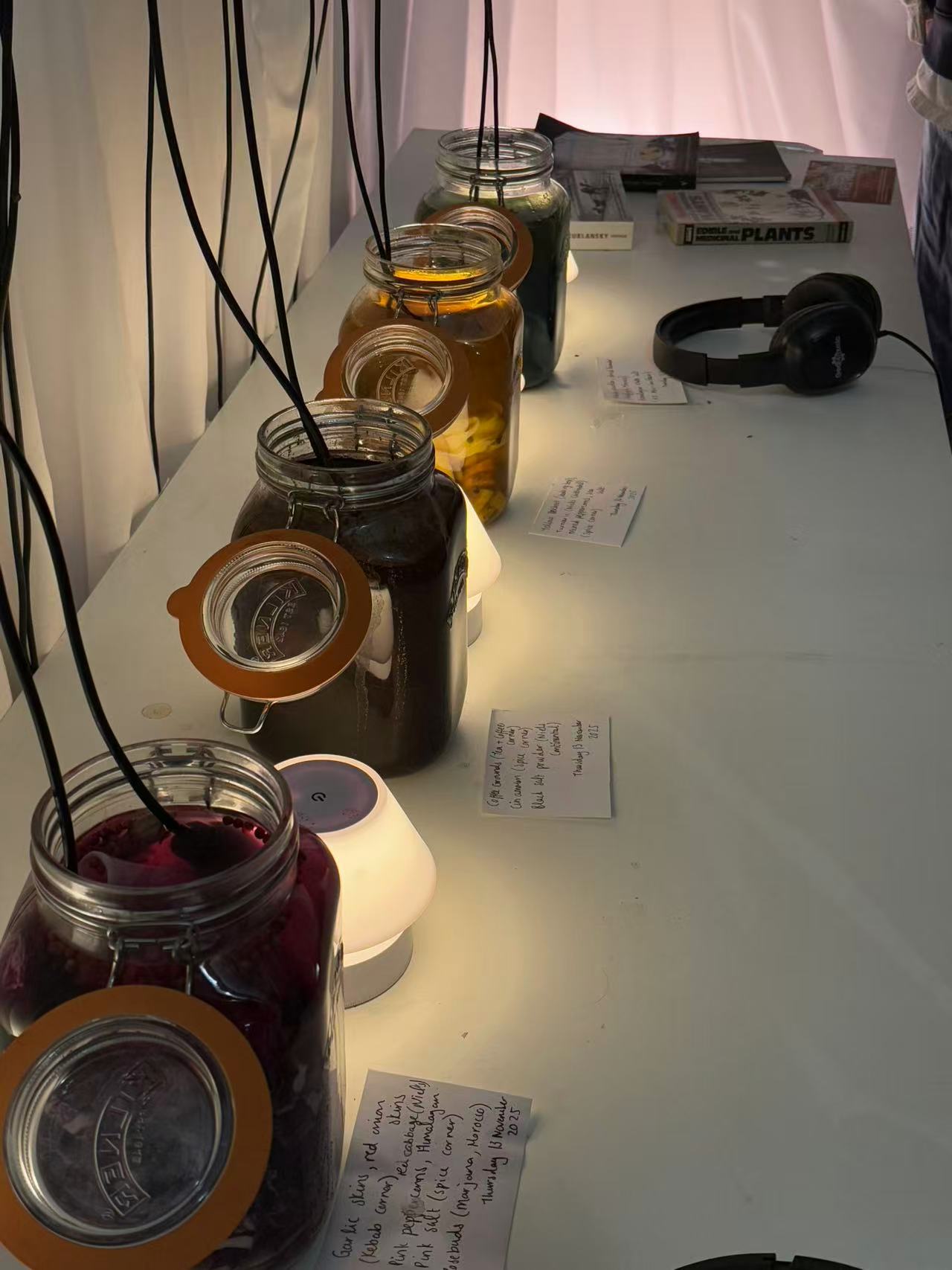
We went to a market outside to collect various sensory experiences that we might encounter, such as smell, hearing and smell, and also experienced various installations, attempting to understand the landscape ecology through the spices and ingredients cultivated in the jars.
2025.11.28
Creative Hacking, Senses and Bodies
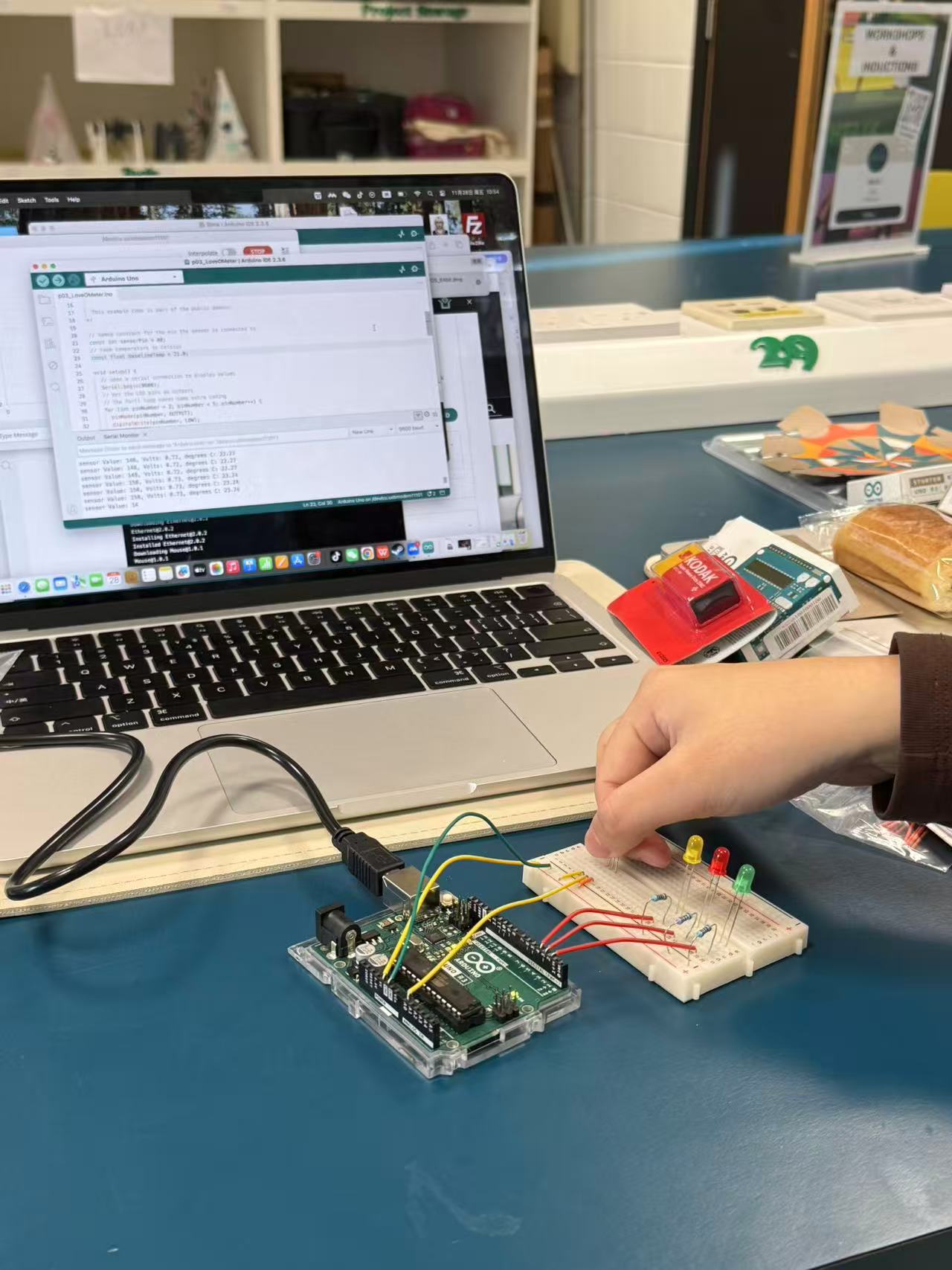
In this class, we made a "little toy" for measuring body temperature with Arduino - the Love-o-meter. The main task is to install the sensor, run the sample code, and then observe how the temperature data changes. Overall, it was a relaxing experience for getting started with hardware.
This Arduino experiment made me truly feel for the first time that "digital technology is measuring me as a person". Although it was just a temperature measurement, it was still quite novel to see the value pop up in the serial port. There were a few minor issues in the middle, such as the wires being plugged in wrongly and the data being unstable. However, I didn't feel too much pressure. Instead, it made me realize that mistakes should be allowed when conducting creative experiments. The overall impression is: It turns out that using hardware to sense the body is not as mysterious as imagined, and it's quite fun. This experience made my understanding of the concept of "body data" more concrete.
2025.12.5
What is your ending
This week's class focuses on "interactive narratives" and explores how digital media can reshape story structures and user roles through Twine implementation. Combining the "post-digital storytelling" theory proposed by Jordan (2019), I have a clearer understanding that the key feature of digital stories is that they are not simply "digitized" texts, but rather a dynamic narrative form generated through the joint efforts of platform mechanisms, user participation, and media materiality.A story is no longer a linear text but a practice that flows among technical structure, author design and user choice. In the class, we experienced various interactive games, and in the Twine we learned to use, I deeply experienced what Jordan called "structural authorship" : Creators no longer have full control over the story but build the narrative framework through tools such as nodes (passages), hyperlinks, and branching structures, allowing readers to interact and write the story together.The Twine stories experienced in the classroom (such as Space Frog) demonstrate Jordan's point: meaning is not preconceived in the text but generated in the reader's action path. The emotional, plot and theme understanding of a story will all change due to the user's choice, which reflects the "process" and "relational" characteristics of post-digital narratives.When creating my own interactive stories, I also personally experienced "configurational narrative" : the logic of the story is not linear writing but spatial, and it requires designing the possible paths and consequences that users might take through a decision-making structure. In practice, this approach prompts me not only to think about how to tell stories.
My Work
2026.4.28
Twine Game Intro and Rationale
This work forms part of our group project portfolio, focusing on "interactive narratives" and exploring how digital media can reshape story structures and user roles through Twine implementation...
Swipe to explore →